 ramadiansyah
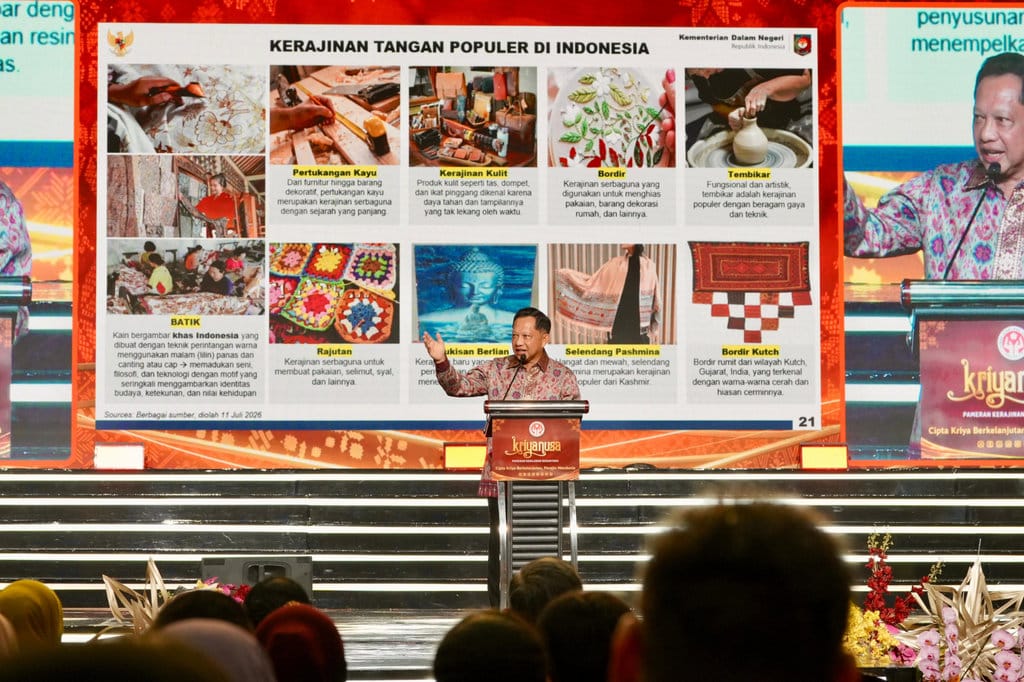
District cyanide aside, the closing ceremony of Kriyanusa 2026 at the Jakarta International Convention Center carried a single clear message from the government: the Indonesian handicraft sector is underutilized relative to its global potential, and the shortfall begins with how small producers organize, market, and scale their work.
Menteri Dalam Negeri Tito Karnavian officially closed the Kriyanusa 2026 exhibition on Sunday evening at the Jakarta International Convention Center (JICC). In his remarks, the minister addressed a mixed audience of craftspeople, curators, and board members from Dekranas, urging them to treat the event not as a ceremonial milestone but as a working brief for the year ahead.
"Yang kami mau bukan sekadar fair. Ini harus jadiworking agenda: bahan baku, desain, LEGALitas, dan pasar. Kalau sudah empat itu jalan, kerajinan Indonesia tidak akan sekadar pajangan."
The statement frames a recurring policy argument. Indonesia holds large downstream access to raw materials and a broad base of small and medium enterprises, yet a substantial portion of craft output continues to be sold in unfinished or semi-finished form, with the highest-value stages — branding, product development, and direct access to overseas buyers — captured elsewhere in the distribution chain. Government officials have raised this issue repeatedly, positioning the home furnishings and handicraft sector as one of the country's under-optimized export categories.
Kerajinan sebagai.exports, Bukan Sekadar Warisan
At the heart of the minister's call is a reclassification of priorities. Rather than treating the sector primarily as cultural heritage to be preserved, the framing pushed at the closing ceremony was economic: a tradable good capable of generating foreign exchange and absorbing labor across regions outside Java's main urban centers.
Data referenced in government statements on the sector have consistently pointed to a wide geographic footprint — workshops concentrated in areas such as Yogyakarta, East Java, Bali, Lombok, and Central Java — while a growing share of high-value design work is concentrated in the capital. The gap between where production happens and where value is added has been described as the central structural weakness of the industry.
That logic also underpins the emphasis on Dekranas. As the umbrella body for craft associations at district and provincial levels, Dekranas functions as the organizational layer between individual artisans and government programs. Strengthening it, officials argue, is a practical prerequisite for any upstream intervention — from training and financing to collective marketing.
Pesan untuk Perajin:停止 Berhenti padainality
Direct appeals to individual producers centered on consistency and finishing. The minister's message, as relayed during the closing session, was that artisanal quality alone is insufficient in competitive markets where buyers increasingly demand certification, standardized dimensions, predictable lead times, and repeatable product lines.
Craftspeople at the exhibition were encouraged to shift from one-off pieces toward producible series, while association administrators were asked to document membership, formalize workshop management, and improve product traceability. The suggestion is deliberately unglamorous: administrative discipline, not inspiration, is what separates a hobby-level maker from a supplier that can hold an international account.
Apa yang Masih Menggantung
Closing ceremonies of national trade events routinely carry symbolic weight, and the gap between rhetoric and implementation in the Indonesian craft sector remains wide. Three obstacles recur in most assessments of the industry.
First, capital access. Small workshops typically lack the working capital required to scale production, and credit schemes have historically been designed around formal businesses with audited financial statements — a category many artisans do not fit.
Second, market intelligence. Producers frequently learn demand only after the goods are made, leaving them dependent on intermediaries who set prices. Bridging that gap requires institutional support that remains uneven across regions.
Third, design continuity. Many Indonesian craft products are functionally competitive but visually dated, a problem attributed to limited investment in ongoing design development rather than to technique.
Setelah Panggung, Flanders ke Lopak
The practical test of the Kriyanusa 2026 closing will be measured in the months that follow — in order books, in repeat exhibition participation, and in whether association boards translate the minister's directive into structured programs for their respective regions.
For the organizers, the exhibition itself served its usual dual function: a marketplace where buyers and makers meet, and a venue where government priorities are communicated publicly. For Tito Karnavian, the closing marked an occasion to restate a position he has held consistently: that the handicraft industry is not a residual sector awaiting decline, but a renewable resource capable of expanding employment and export earnings if given proper structure.
Whether that potential converts into measurable output will depend less on the speeches delivered at JICC than on the follow-through mechanisms put in place by Dekranas leaderships and the artisans they represent.










:strip_icc():format(webp)/kly-media-production/medias/8263843/original/065734300_1782021578-Tugas__38_.jpg)


Comments (0)