 hafiz-rahman
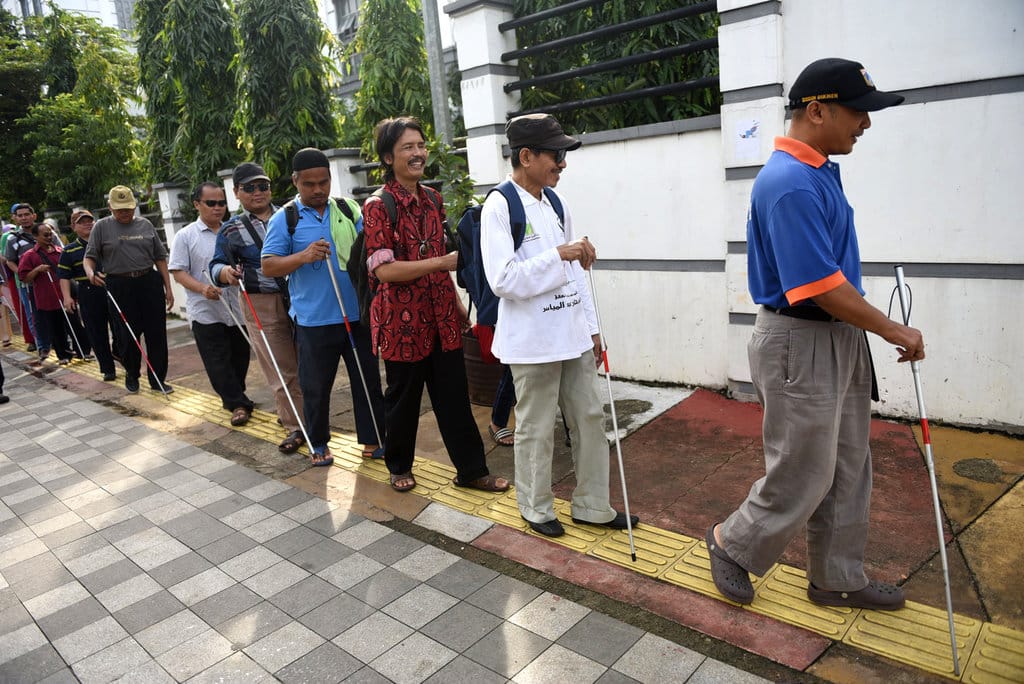
Baru weeks terakhir, residents of Pontianak, Kalimantan Barat, directing attention to a seemingly trivial detail on a public pedestrian path: a set of stickers affixed precisely on top of tactile guiding blocks installed on the sidewalk. The stickers, which look like signage or labels, do not merely sit beside the tactile path — they occupy it. As a result, the raised pattern meant to guide visually impaired pedestrians from blind persons to low-vision users and wheelchair users is covered, compressed, and rendered useless.
At first glance, the incident appears small enough to be dismissed as a mere municipal work oversight. In fact, the case illustrates a structural problem that repeats in many cities: accessibility features are installed to satisfy regulations at the construction stage, then quietly destroyed or shifted by other actors who do not understand the function of the components they alter.
Guide Blocks Are Not Decoration
Tactile guiding blocks — locally often called guiding block or pathway pemandu — are engineered surfaces composed of raised lines and bumps that transmit vibration and directional cues through a white cane, through the soles of footwear, or through wheelchair wheels. The pattern is not aesthetic. Its geometry encodes information: parallel lines indicate a straight route, branching lines indicate a turn, and dome-shaped surfaces warn of a hazard such as a staircase opening, a platform edge, or an intersection with vehicle traffic.
When a label covers the guiding block, the sidewalk is not obstructed in the physical sense. Yet for the user, the path simply ends without warning.
The presence of a sticker on that surface eliminates the tactile contrast and creates a slippery or uneven layer. For a blind pedestrian relying on the tip of a cane, the difference is the difference between a navigable route and a guessing route. This is why the case should not be treated as a trivial public-order issue.
Why Non-Compliance Occurs
Verification of field conditions shows three recurring causes of the failure of accessibility paths. First, the guiding path was installed by one unit, while stickers, banners, or promotional labels were placed by another unit or a private party with no coordination. Second, the audit was performed only once, at handover of the project, without periodic re-inspection. Third, maintenance budgets are almost never allocated specifically for tactile paths, because the damage is invisible to the general public and therefore generates no complaints.
This pattern shows that accessibility is treated as a one-time construction obligation rather than as a continuous service commitment. Data from national disability statistics illustrate the scale of the affected group: based on the 2023 Central Bureau of Statistics figure, the number of persons with disabilities in Indonesia reaches approximately 29 million people, or roughly six percent of the population. Every element of a guiding path serves millions of users on a daily basis.
The Regulatory Standard Is Clear
Indonesia has adopted an accessibility framework that includes the ratification of the United Nations Convention on the Rights of Persons with Disabilities through Presidential Decree Number 74 of 2016, as well as technical standards for buildings and infrastructure issued by the Ministry of Public Works and Housing. Within those rules, the guiding path is not an optional extra. It is a mandatory element of the pedestrian path, complete with its own dimensional and material specifications, placement requirements, and warning surfaces at hazardous points.
Compliance requires at least three things: that the tactile pattern remain fully exposed and unobstructed, that the material maintain its consistency and durability, and that the surrounding surface remain level so that wheelchair users and users of crutches can move without obstacles. A sticker placed directly on top of the guiding block violates the first requirement outright.
Consequences for Users
The impact is not limited to discomfort. Blind pedestrians who lose tactile orientation often stop abruptly, wander into traffic lanes, or are forced to ask strangers for help — exposing them to the risk of accidents and to security and dignity concerns. Wheelchair users encounter a different obstacle: a coating that changes traction and thickness can cause a small wheel to jam or slip. Meanwhile, older people with mobility limitations and parents pushing strollers experience the same physical hazard.
From a legal perspective, the failure of a facility to remain accessible constitutes a mismatch between the physical condition of the infrastructure and the guarantee of equal access guaranteed by law. From an economic perspective, the cost of repair and re-marking a tactile path is minimal compared with the cost of a single accident involving a pedestrian who falls because a hazard marker was concealed.
What Needs to Change
Based on the verification of the pattern, several corrective steps appear necessary. Local governments need to map all existing guiding paths and verify their physical condition, not only their presence in planning documents. Placement of stickers, promotional labels, or temporary signage on tactile surfaces must be prohibited through explicit regulation, with penalties for violations. Maintenance of accessibility features must be included as a line item in routine city budgets. Finally, audits should involve persons with disabilities directly, since users are the only parties capable of detecting the loss of function in a tactile path.
The lesson from the Pontianak case is simple: accessibility fails not because standards are lacking, but because implementation stops after the project is declared complete. A guiding path that is covered, worn, or obstructed is functionally identical to one that was never built at all.











:strip_icc():format(webp)/kly-media-production/medias/8263843/original/065734300_1782021578-Tugas__38_.jpg)



Comments (0)