 sinta-pradana
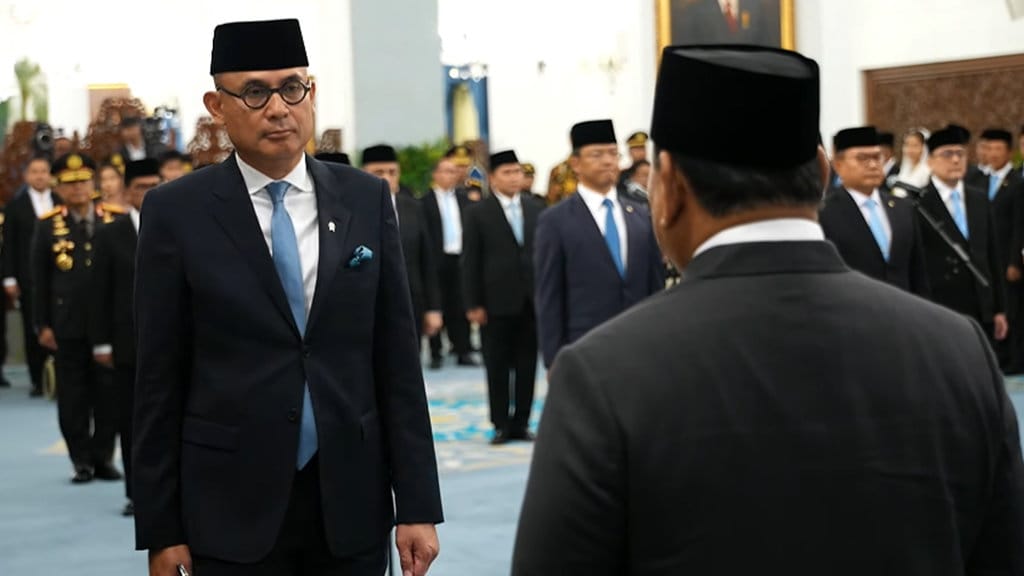
Arrmanatha Christiawan Nasir resmi dilantik menjadi Menteri Luar Negeri,umptions replacing Sugiono, completing a leadership change in Indonesia's top diplomatic post. The handover took place in Jakarta with a swearing-in ceremony, marking the end of Sugiono's tenure and the start of a new chapter for one of the most widely recognized career diplomats in the Foreign Ministry.
The transition follows a broader reshuffle in which several state ministers received new assignments. For Arrmanatha Nasir, however, the appointment is less a break with tradition than the continuation of a long institutional career built almost entirely within the diplomatic corps. He is known as a figure who has spent more than two decades navigating multilateral forums, bilateral negotiations, and delicate consular affairs.
Who The Man Is
Arrmanatha Christiawan Nasir was born in Tarakan, North Kalimantan, and completed his education at the Department of International Relations, Universitas Indonesia, before pursuing advanced studies in international law. His academic background is often cited as part of the reason his name surfaced repeatedly in discussions about Indonesia's negotiating positions at the World Trade Organization, the United Nations, and the Organisation for Economic Co-operation and Development.
Within the Ministry of Foreign Affairs, he is classified as a career diplomat, a distinction reserved for officials who enter the service through the diplomatic candidate recruitment scheme and rise through the regular hierarchy. That status matters: as a career diplomat, his appointment does not represent a political party quota or a party figure being placed in a strategic cabinet slot, but rather the elevation of a professional operator with institutional continuity.
Diplomatic Track Record
His overseas postings are extensive. He has served in several European destinations, including the Netherlands, Hungary, and Belgium, before taking on higher-ranking assignments. Among the most prominent roles were Ambassador of the Republic of Indonesia to Switzerland, concurrently Permanent Representative to the United Nations Office at Geneva, and Ambassador to the Holy See, concurrently Permanent Representative of Indonesia to the United Nations in Rome.
The Geneva post was arguably the most demanding of his career. Indonesia, as a WTO founding member without a permanent representation in Geneva for decades, relied heavily on its ambassador there to defend its interests in trade disputes and to support the country's bid for membership in the OECD. His years in Switzerland also involved coordination with other Indonesian missions in Europe and participation in the regular cycle of United Nations General Assembly and Human Rights Council sessions.
In Rome, his mandate added a religious and consular dimension, given that the Holy See accreditation covers a substantial community of Indonesian expatriates and pilgrims. He also handled protocol functions linked to visits by national leaders, which is precisely the field he later oversaw at the ministry level.
Beyond ambassadorships, Arrmanatha Nasir held structural positions in the Foreign Ministry, including leadership roles in the directorate general dealing with protocol and consular affairs. That particular assignment shaped his understanding of the ministry's internal machinery: consular protection for citizens abroad, diplomatic ceremony management, and coordination among Indonesian missions scattered across more than one hundred countries.
Wealth Disclosure
Like every state minister, Arrmanatha Nasir is obliged to submit a declaration of wealth to the Corruption Eradication Commission before formally taking office. The disclosure is an administrative requirement, but it has become a routine point of public scrutiny because many Indonesians follow ministerial declarations as an accountability measure.
The initial wave of media attention focused on how quickly and transparently the file was submitted, followed by scrutiny of the declared assets, which by convention are listed in aggregated categories rather than itemised in full. Analysts generally treat the filing as a starting point for verification rather than a standalone measure of integrity.
What Lies Ahead
The challenges facing the new Minister are substantial and largely inherited rather than self-created. Indonesia continues to navigate a crowded South China Sea, competing regional powers in the Indo-Pacific, an increasingly complex trade environment, and active membership in a growing number of multilateral institutions that demand constant diplomatic presence.
The unusual aspect of this appointment is its procedural character: a career diplomat replacing a politician from a major party, which leaves the question of how the balance between political directives and institutional expertise will be drawn. Observers close to the ministry note that continuity in the civil-service structure often cushions such transitions, since most negotiating work is carried out by career officials regardless of who occupies the ministerial chair.
For now, the immediate attention will fall on the next weeks: the design of the ministerial leadership structure, the allocation of vice-ministerial portfolios, and the first foreign policy statements delivered under the new leadership. Arrmanatha Nasir's track record suggests a style that leans on technical preparation and multilateral engagement rather than public-facing rhetoric, a profile markedly different from his predecessor.







:strip_icc():format(webp)/kly-media-production/medias/8263843/original/065734300_1782021578-Tugas__38_.jpg)


Comments (0)